Penetration
Testing-as-a-Service (PTaaS)
Penetration Testing-as-a-Service (PTaaS) simulates real-world cyberattacks to identify exploitable vulnerabilities before malicious actors can. Reinvent Security's expert ethical hackers assess the effectiveness of your security controls and provide actionable remediation guidance to strengthen your defenses.
Reinvent Security delivers Penetration Testing-as-a-Service through a structured seven-step lifecycle: Scope, Reconnaissance, Vulnerability Analysis, Exploitation, Post-Exploitation, Reporting, and Retesting. This methodology simulates real-world cyberattacks to identify exploitable weaknesses and provide actionable remediation guidance, enabling organizations to strengthen their security posture and resilience.

Our Strategic Approach
Scope
Recon
Analyze
Exploit
Post-Exploit
Report
Reset
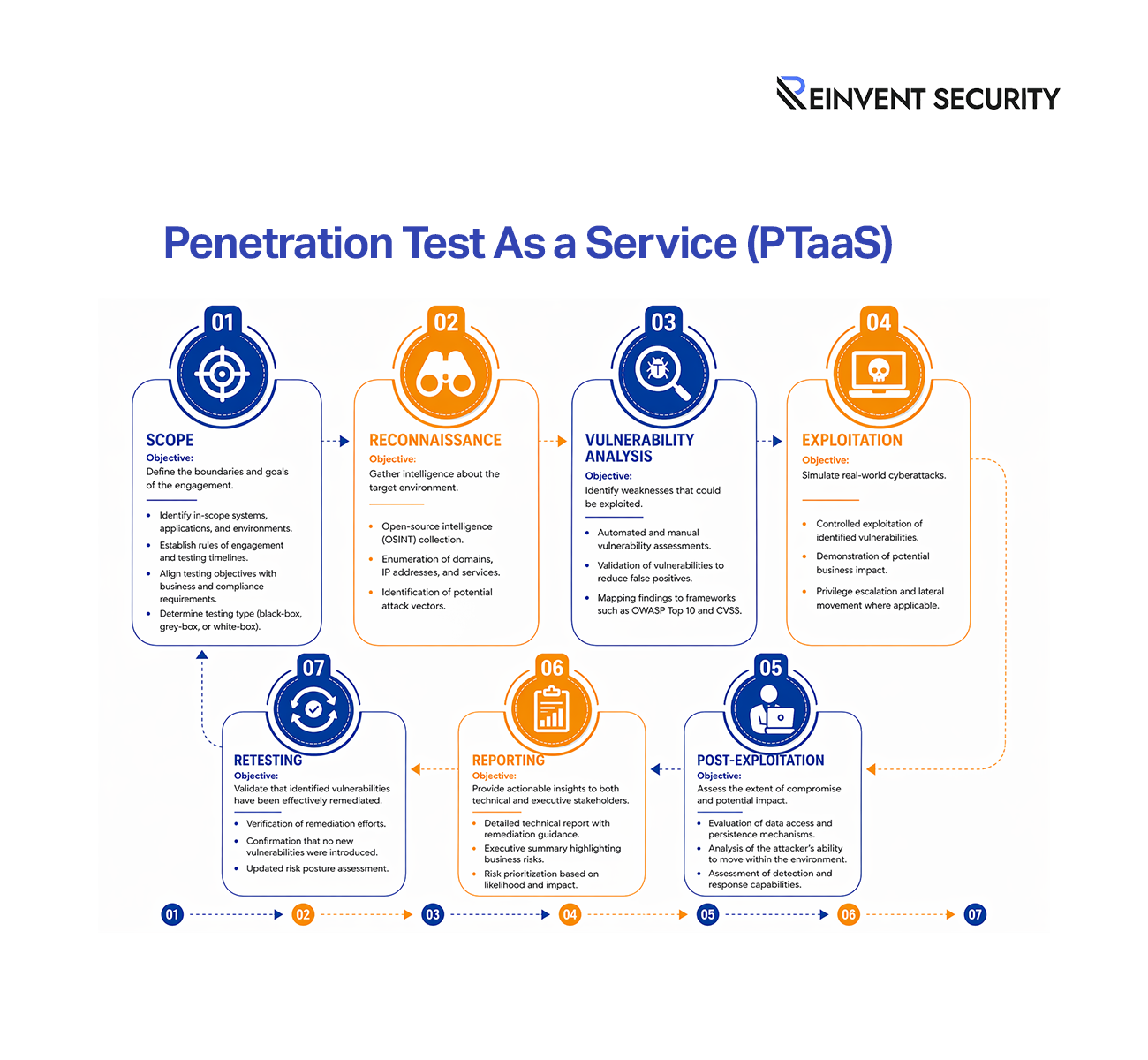
Scope
- Objective: Define the boundaries and goals of the engagement.
- Identify in-scope systems, applications, and environments.
- Establish rules of engagement and testing timelines.
- Deliverables: SoW, Rules of Engagement (RoE), and Testing Plan.
Reconnaissance
- Objective: Gather intelligence about the target environment.
- Open-source intelligence (OSINT) collection.
- Enumeration of domains, IP addresses, and services.
- Deliverables: Reconnaissance summary and Attack surface map.
Vulnerability Analysis
- Objective: Identify weaknesses that could be exploited.
- Automated and manual vulnerability assessments.
- Validation of vulnerabilities to reduce false positives.
- Deliverables: Validated vulnerability list mapped to OWASP & CVSS.
Exploitation
- Objective: Safely attempt to exploit identified vulnerabilities.
- Bypass security controls to confirm exploitability.
- Demonstrate real-world risk without disrupting operations.
- Deliverables: Evidence of successful exploitation and access.
Post-Exploitation
- Objective: Determine the value and impact of compromised assets.
- Simulate lateral movement and data exfiltration attempts.
- Assess the persistence of the breach within the environment.
- Deliverables: Impact analysis and lateral movement report.
Reporting & Retesting
- Objective: Communicate findings and verify remediation.
- Comprehensive technical and executive reporting.
- Follow-up testing to confirm all vulnerabilities are closed.
- Deliverables: Final Security Report and Remediation Certificate.
Capabilities
Key Features
Web application penetration testing
Network and infrastructure testing
Cloud security penetration testing
External and internal assessments
Wireless security testing
Social engineering assessments (optional)
Retesting and validation of remediation
Continuous or periodic testing options
Core Benefits
Ideal For
- Organizations preparing for compliance audits
- Enterprises with customer-facing applications
- Businesses seeking to validate their security posture